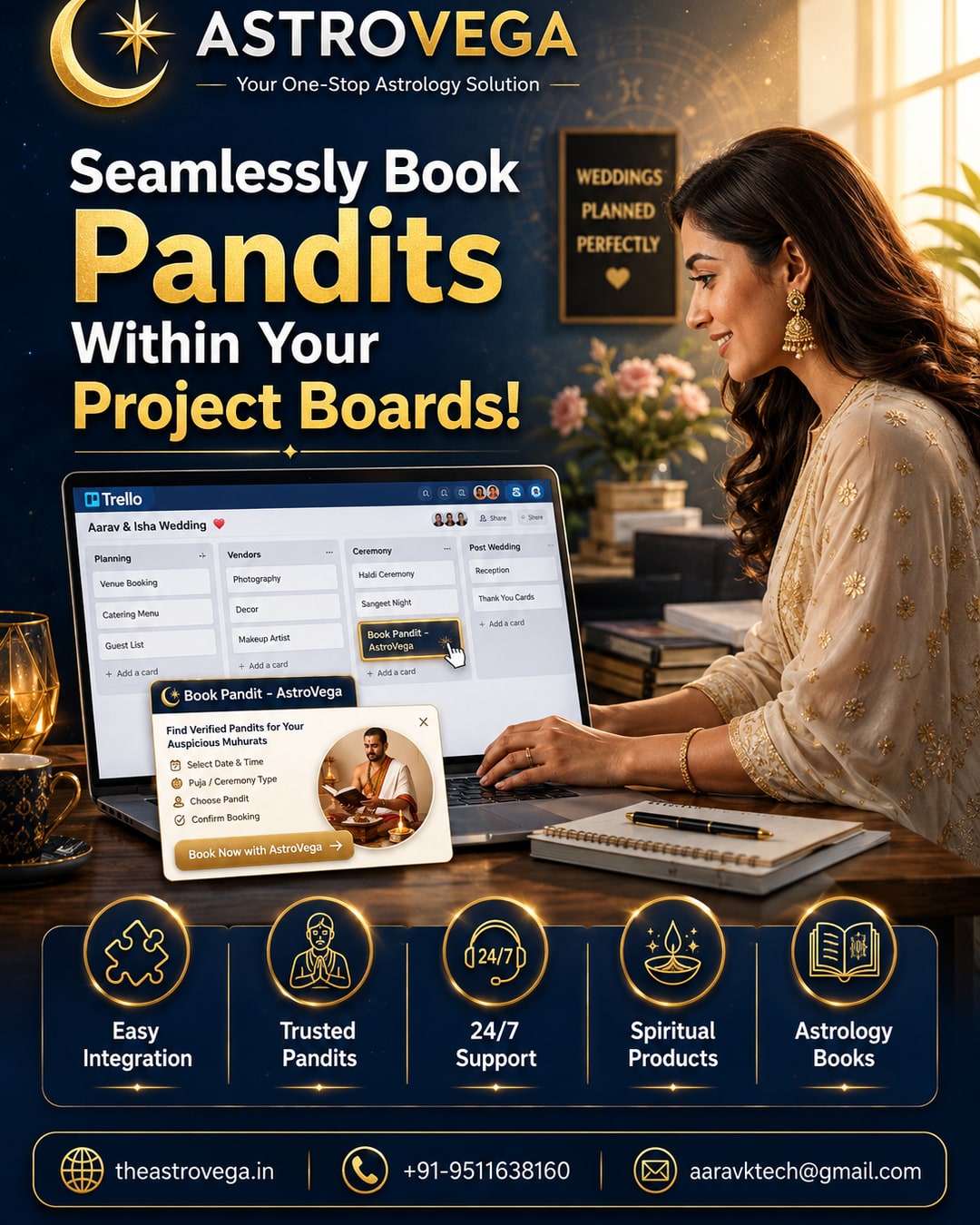
Wedding and event planners already live inside Trello or Asana boards - AstroVega now lets them drop a Pandit or muhurat booking link right into that same checklist.
How Wedding Planners Are Booking Pandits Without Leaving Their Trello Board
If you plan weddings for a living, your Trello or Asana board is probably where everything happens - vendor calls, decor mood boards, catering deadlines, the seating chart drama. Astrology bookings, though, usually sit outside all of that. A voice note here, a WhatsApp thread there, a sticky note about the shubh muhurat date that somehow never makes it into the actual project board. AstroVega is closing that gap.
Why astrology bookings keep falling through the cracks Most professional planners juggle five or six vendor categories per wedding, and each one lives inside the board as a task card with a deadline and an owner. Pandit and muhurat bookings rarely get the same treatment because there's historically been no direct way to attach a booking action to a card - so it becomes a verbal reminder instead of a tracked task, and verbal reminders are exactly what slip during a hectic wedding week.
What changes with AstroVega inside the board An AstroVega Pandit or muhurat booking link can now sit on its own card, right next to the caterer and the florist. A planner opens the card, browses verified astrologers or Pandits by tradition and availability, and confirms the muhurat date - all without opening a fifth app or hunting for a phone number in an old chat thread. The card status updates, the client sees it, and nothing gets forgotten in the scramble.
Why this matters more during peak wedding season During high-demand weeks, Pandit availability tightens fast, and planners coordinating multiple weddings at once genuinely cannot afford to keep astrology logistics off their main board. Centralizing it where the rest of the checklist already lives means one less place to check, one less thing to remember out loud on a call.
What this is not This isn't a replacement for the planner's judgment or the family's own preferences - it's simply removing the friction of where the booking action happens. The consultation itself, the muhurat guidance, the Pandit's expertise, all of that stays exactly as it is; only the access point moves closer to where planners already work.
My take: if you're a solo wedding planner juggling two or three events a season, this saves you from being the accidental astrology-coordination bottleneck between the family and the Pandit. If you run a full planning agency with a team split across vendor categories, it's arguably more useful - anyone on the team can see the muhurat status without pinging you directly. Either way, the value isn't a new feature to learn, it's one less app to remember to check.
🌐 theastrovega.in · 📞 +91-9511638160 · 📧 aaravktech@gmail.com